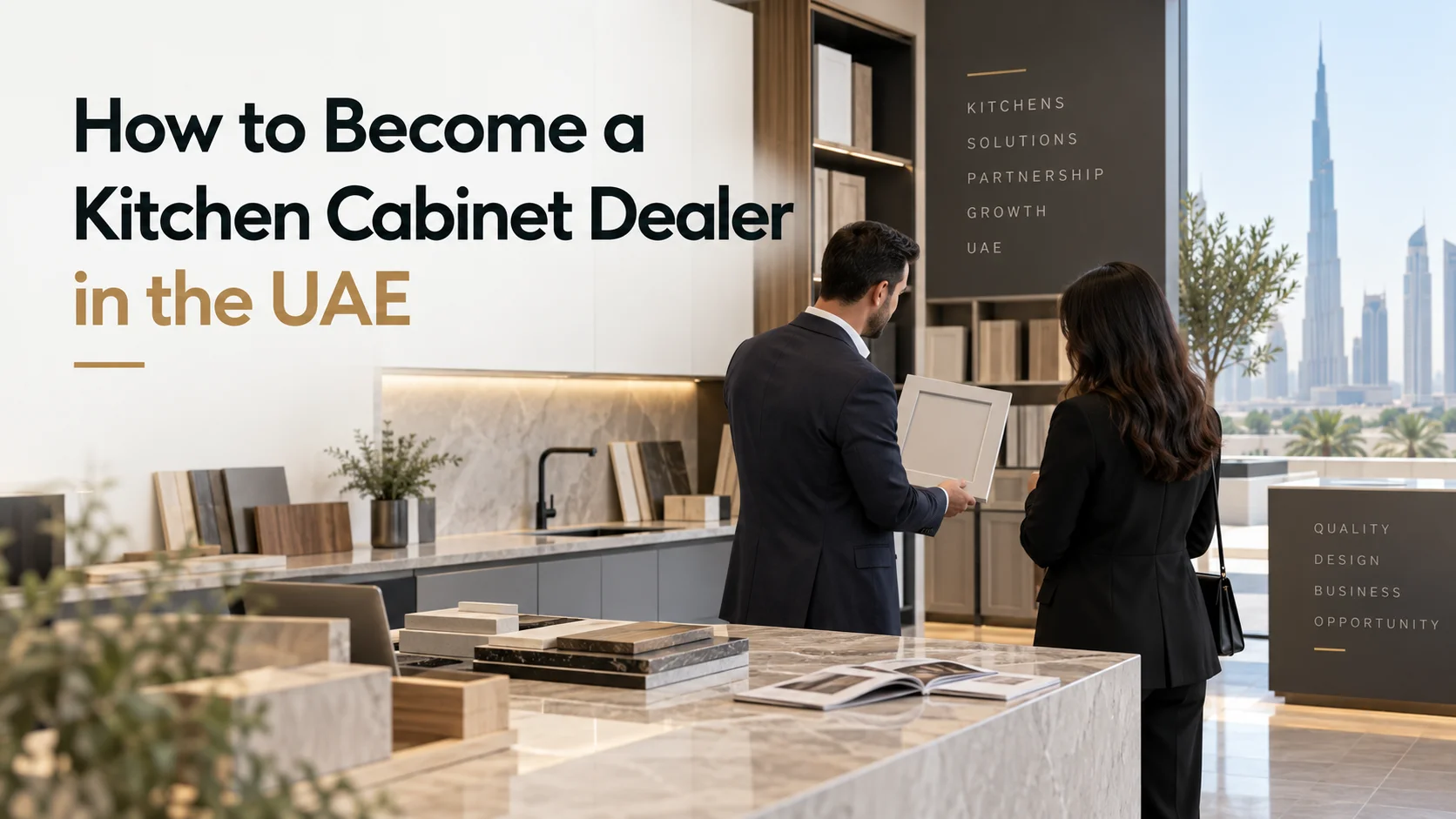

The UAE offers attractive opportunities for entrepreneurs entering the kitchen cabinetry industry, supported by residential development, property investment, and demand for modern interior solutions. According to 6Wresearch’s UAE Cabinet Market Outlook, the UAE cabinet market was estimated at US$169 million in 2025 and is projected to reach US$226 million by 2032, representing a forecast compound annual growth rate (CAGR) of 4.2% from 2026 to 2032. This estimate covers the broader cabinet market, including kitchen and bathroom cabinets, rather than kitchen cabinets alone.
Construction activity provides further context for this opportunity. Dubai Municipality reported that Dubai processed more than 30,000 building permit applications in the first half of 2025, a 20% increase year over year. The licensed built-up area exceeded 5.5 million square metres, including more than 2 million square metres allocated to residential villas.
For entrepreneurs considering becoming a kitchen cabinet dealer in the UAE, these indicators point to potential demand from homeowners, property developers, contractors, and interior designers. However, market growth alone does not guarantee profitability. Success depends on selecting the right supplier, understanding local customer needs, managing project delivery, and building a reliable sales pipeline.
- Understand the Kitchen Cabinet Dealership Business Model
- Step 1: Research the UAE Kitchen Cabinet Market
- Step 2: Choose the Right Kitchen Cabinet Supplier
- Step 3: Prepare a Business Plan and Estimate Startup Costs
- Step 4: Decide Whether to Open a Showroom
- Step 5: Build a Competitive Product and Service Offering
- Step 6: Build a Strong Cabinet Sales and Marketing Strategy
- Step 7: Consider a Kitchen Cabinet Franchise or Dealership Program
- Step 8: Manage Delivery, Installation, and Customer Relationships
- Common Mistakes to Avoid
- Conclusion
- FAQs
Understand the Kitchen Cabinet Dealership Business Model
A kitchen cabinet dealership connects manufacturers with homeowners, property developers, contractors, and interior design professionals. Rather than manufacturing cabinets, the dealer focuses on presenting products, understanding customer requirements, preparing quotations, managing orders, and coordinating local services.
There are several ways to establish a dealership:
- Independent dealership: Source products from one or more manufacturers and build your own brand.
- Authorized dealership: Represent an established manufacturer and benefit from its product range, brand identity, and dealer support.
- Cabinet franchise: Operate under a structured brand arrangement, subject to the franchisor’s terms, fees, and operating requirements.
- Referral or commission-based partnership: Generate qualified leads and coordinate local customer relationships while the manufacturer manages selected technical and fulfillment activities.
For first-time investors, an authorized dealership or a structured manufacturer partnership can offer a more manageable entry point than building a factory or developing an entirely new brand.
To understand the fundamentals, read OPPOLIA’s guide on how to start a cabinet dealership business. It explains market research, supplier selection, showroom planning, business development, and customer service in greater detail.
Step 1: Research the UAE Kitchen Cabinet Market
Before investing in a showroom or signing a supplier agreement, validate local demand.
Start by researching competitors in your intended service area. Compare their kitchen styles, customization options, materials, warranties, delivery estimates, installation services, and pricing structures. Review customer feedback to identify common complaints, such as delayed installation, inconsistent finishes, or poor after-sales support.
Next, speak with potential customers. Interview contractors, interior designers, renovation companies, and property owners to understand their purchasing criteria. Ask about average project sizes, preferred materials, expected lead times, and recurring problems with existing suppliers.
Your research should answer four questions:
- Which customer segment offers the strongest opportunity?
- What cabinet styles and price ranges are underserved?
- How will your business differentiate itself from established showrooms?
- Can your supplier meet the quality, customization, and delivery requirements of UAE projects?
Use these findings to develop a realistic business plan rather than relying solely on national market forecasts.
Step 2: Choose the Right Kitchen Cabinet Supplier
A dependable manufacturer is central to the long-term success of a kitchen cabinet dealership. Your supplier affects product quality, pricing, delivery reliability, customization capabilities, and the customer experience.
Evaluate potential partners against the following criteria:
Product quality and durability: Review cabinet construction, finishes, hardware, moisture resistance, and quality-control procedures. Request samples and inspect completed projects whenever possible.
Product range: Choose a supplier that can serve your target segment with suitable door styles, colors, materials, storage configurations, and countertop options.
Production capacity: Confirm whether the manufacturer can handle both individual residential orders and larger developer projects. Ask about production planning, packaging, shipping, and procedures for resolving damaged or missing components.
Technical and commercial support: Look for design assistance, quotation tools, product training, installation guidance, marketing resources, and clear warranty terms.
Customization and scalability: A flexible product portfolio can help your business move from individual kitchen orders into wardrobes, bathroom vanities, and broader interior furnishing projects.
Entrepreneurs should also compare landed costs, including international freight, customs duties where applicable, insurance, local delivery, installation, and after-sales expenses.
Step 3: Prepare a Business Plan and Estimate Startup Costs
The investment required to become a kitchen cabinet dealer in the UAE depends on your business model, location, showroom size, product positioning, and staffing requirements. There is no single startup budget that applies to every dealership.
Your financial plan should include the following cost categories:
| Cost category | What to budget for |
|---|---|
| Business setup | Company registration, licensing, approvals, and professional fees |
| Showroom | Rent, fit-out, signage, lighting, and utilities |
| Product displays | Kitchen mock-ups, samples, hardware, and finish boards |
| Staffing | Sales consultants, designers, administration, and project coordination |
| Marketing | Website, local SEO, social media, photography, and lead generation |
| Logistics | Freight, customs where applicable, local delivery, and storage |
| Installation | Contractors, site measurements, tools, and project supervision |
| Working capital | Deposits, supplier payments, operating expenses, and unexpected costs |
Before committing funds, verify the relevant business activity, licensing requirements, and permitted sales or import activities with the appropriate UAE authority. Requirements can vary between mainland and free-zone setups, and additional approvals may apply depending on the business model.
Prepare conservative, expected, and optimistic financial scenarios. Estimate monthly qualified leads, quotation-to-order conversion, average order value, gross margin, and fixed operating expenses.
Calculate your break-even sales level using your actual costs. For example, if monthly fixed costs are AED 40,000 and your contribution margin after variable costs is 25%, you would need approximately AED 160,000 in monthly sales to cover those fixed costs. This is an illustrative calculation, not a UAE industry benchmark.
Step 4: Decide Whether to Open a Showroom
A physical showroom allows customers to inspect materials, compare finishes, test storage features, and discuss kitchen layouts with a design consultant. It can also provide a professional meeting space for contractors and interior designers.
However, a large showroom is not always the best starting point. Entrepreneurs with limited capital may begin with a compact display studio, sample library, and digital design service, provided the chosen business model and licensing arrangements permit it.
A showroom should demonstrate the products most relevant to your target customers. Consider including:
- Contemporary and minimalist kitchen displays
- Different cabinet door styles and finishes
- Practical storage and drawer systems
- Countertop and hardware samples
- Examples of completed residential projects
- Digital or 3D kitchen design presentations
Choose a location based on customer accessibility, visibility, rental costs, nearby complementary businesses, and proximity to your target projects. A premium retail showroom may benefit from a different location than a business focused on contractor and developer accounts.
Step 5: Build a Competitive Product and Service Offering
UAE customers have diverse preferences ranging from budget-conscious apartment renovations to premium villa interiors. Competitive dealers should offer options at various price points without compromising essential quality standards.
Provide clear specifications and explain the differences in cabinet materials, finishes, hardware, storage configurations, and levels of customization. Help customers understand the trade-offs between price, durability, maintenance, appearance, and delivery time.
Service is equally important. Establish a consistent process for site measurements, design approval, quotations, order confirmation, installation coordination, and after-sales support.
For larger projects, prepare detailed quotations and product schedules. Before an order enters production, confirm dimensions, quantities, finishes, hardware, delivery responsibilities, and installation scope. Documenting these details helps reduce costly errors and disputes.
Step 6: Build a Strong Cabinet Sales and Marketing Strategy
Generating qualified leads is one of the most important responsibilities of a kitchen cabinet dealer. A combination of digital marketing and professional networking can help you establish a consistent sales pipeline.
Invest in Local SEO
Create website pages targeting relevant searches such as:
- Kitchen cabinet dealer UAE
- Kitchen cabinet supplier in Dubai
- Kitchen cabinets in Abu Dhabi
- Custom kitchen cabinets UAE
- Kitchen cabinet showroom UAE
Develop useful pages for individual services, product categories, and locations you genuinely serve. Include original project photographs, clear product descriptions, customer testimonials, and accessible contact information.
A well-structured Google Business Profile, where eligible, can improve your local visibility. Encourage genuine customer reviews and keep your business details accurate.
Develop Partnerships
Build relationships with interior designers, architects, contractors, property developers, and renovation companies. These professionals can introduce your business to customers who already need cabinetry.
Offer clear product specifications, responsive quotations, dependable communication, and transparent commercial terms to strengthen these relationships.
Use Visual Marketing
Kitchen cabinets are highly visual products. Share completed projects, design comparisons, material samples, storage ideas, and before-and-after transformations through suitable digital channels.
Use these materials to demonstrate your capabilities rather than relying solely on promotional claims.
Establish a Repeatable Sales Process
A professional sales process should include lead qualification, measurements, design consultation, quotation, order confirmation, production coordination, delivery planning, and after-sales support.
Respond promptly to inquiries and explain pricing, specifications, timelines, and exclusions clearly. Consistent communication builds trust and can increase referrals.
Step 7: Consider a Kitchen Cabinet Franchise or Dealership Program
Entrepreneurs who prefer to work with an established manufacturer can investigate a dealership or franchise-style partnership instead of developing an entirely independent product brand.
A cabinet franchise or authorized dealership arrangement may offer access to established product collections, brand assets, sales training, technical support, and showroom guidance. The exact benefits depend on the supplier’s contract and program structure.
Before signing, clarify whether the arrangement is an exclusive dealership, a non-exclusive distribution agreement, or a formal franchise. Review territory rights, minimum purchase commitments, display requirements, payment terms, marketing obligations, warranty responsibilities, and termination conditions.
OPPOLIA provides an established cabinetry and interior furnishing product portfolio, including kitchen cabinets, wardrobes, bathroom vanities, interior doors, and other whole-house solutions. Entrepreneurs interested in this model can explore the OPPOLIA dealership program to understand the broader dealership approach and evaluate whether the opportunity fits their business objectives.
Request written confirmation of program availability and specific terms for the UAE rather than assuming that every support feature or commercial condition is offered in every market.
Step 8: Manage Delivery, Installation, and Customer Relationships
A successful kitchen cabinet dealer sells more than cabinetry. The business must coordinate design approvals, manufacturing, delivery, installation, and after-sales service.
For imported products, establish a realistic timeline that accounts for production, shipping, customs clearance, local transport, and site readiness. Confirm who is responsible for each stage and communicate potential delays promptly.
Work with qualified installation partners and create a documented inspection process. Check dimensions, product condition, hardware, finish consistency, and installation quality before project handover.
After completion, request customer feedback and photographs, resolve outstanding issues, and maintain a record of warranty claims. Satisfied homeowners can generate referrals, while reliable project delivery can lead to repeat orders from contractors and developers.
Common Mistakes to Avoid
New dealers often underestimate working-capital requirements, choose suppliers based only on purchase price, or invest too heavily in showroom displays before validating demand.
Other risks include unclear installation responsibilities, unrealistic delivery promises, weak lead follow-up, and insufficient differentiation from competitors.
Reduce these risks by validating your target market, obtaining written supplier terms, maintaining adequate cash reserves, setting measurable sales targets, and establishing clear processes for quotations and project handovers.
Conclusion
The UAE’s cabinet market offers a potential opportunity for entrepreneurs who combine careful market research with dependable products, effective sales development, and professional project management. Building a sustainable dealership requires more than finding a supplier: it means creating a business that customers and industry partners can rely on.
Take the next step toward building your cabinet business by exploring the OPPOLIA dealership program. Whether you’re planning a new showroom or expanding an existing business, contact our team to discuss dealership opportunities and how they could fit your goals in the UAE.
Contact OPPOLIA to learn about program requirements, available support, and the application process.
FAQs
Start by researching local demand, defining your target customers, and selecting a suitable business model. Evaluate manufacturers, prepare an investment plan, obtain the appropriate business license, and establish a showroom or another suitable sales channel. You can also contact OPPOLIA to discuss its dealership program and application requirements.
Investment varies according to showroom size, licensing, product displays, staffing, marketing, logistics, and working capital. Prepare a detailed budget and validate local costs before committing to a lease or supplier agreement. A compact studio and a large retail showroom will have very different financial requirements.
Not necessarily. A showroom can help customers evaluate materials and finishes, but some business models begin with a small studio, digital consultations, and sample presentations. Your setup should match your target market and comply with the licensing conditions applicable to your business.
Compare product quality, customization options, production capacity, pricing, shipping arrangements, warranties, technical support, and delivery reliability. Request samples, verify references, and calculate the total landed cost rather than comparing factory prices alone.
Previous experience in furniture, cabinetry, interior design, or building materials can be beneficial, but requirements vary by manufacturer and dealership model. Sales ability, customer service, financial planning, and operational management are also important. Ask potential partners whether they provide product training, design guidance, and sales support.
OPPOLIA publishes a global partnership program that outlines dealership support, training, showroom guidance, and marketing assistance. Entrepreneurs interested in becoming a partner should contact OPPOLIA directly to confirm UAE territory availability, eligibility criteria, investment expectations, commercial terms, and the application process.