

For contractors working on Singapore HDB projects, choosing the right bathroom vanity requires more than selecting a style and color. A well-designed vanity must fit the available space, accommodate existing plumbing, withstand Singapore’s humid environment, provide sufficient storage, and remain practical for daily cleaning.
Bathroom vanities are particularly important in HDB bathrooms because floor area is limited. A custom vanity can use otherwise wasted wall space, conceal plumbing, integrate storage, and coordinate with the basin, mirror cabinet, tiles, and other bathroom fittings.
For residential projects, the best approach is to evaluate the vanity manufacturer based on five factors: material durability, dimensional flexibility, moisture resistance, design capability, and installation support.
- Why Choose Custom Bathroom Vanities for an HDB Bathroom?
- 1. Measure the HDB Bathroom Before Selecting a Vanity
- 2. Select Materials Designed for Singapore’s Humid Environment
- 3. Choose Between a Floating and Floor-Standing Vanity
- 4. Select the Right Vanity Top and Basin
- 5. Plan Storage Around How the Bathroom Is Used
- 6. Coordinate the Vanity With the Overall Interior Design
- 7. 5 Custom Bathroom Vanity Suppliers in Singapore
- 8. Ask About Manufacturing and Installation Capability
- 9. Custom vs. RTA Bathroom Vanities
- 10. Final Checklist for Selecting HDB Bathroom Vanities
- Looking for a Reliable Bathroom Vanity Manufacturer in Singapore?
- FAQs about bathroom vanity for HDB bathroom
Why Choose Custom Bathroom Vanities for an HDB Bathroom?

Standard vanity cabinets are designed around predetermined dimensions. This can create problems in compact HDB bathrooms, where plumbing locations, door clearances, shower areas, and wall dimensions can vary from one project to another.
A custom bathroom vanity allows contractors and designers to specify the width, depth, height, storage configuration, finish, countertop, basin position, and hardware according to the actual site conditions.
Customisation is particularly useful when:
- The bathroom has a narrow or irregular layout.
- Existing plumbing cannot easily be relocated.
- The vanity needs to fit beside a shower screen or toilet.
- The project requires a specific storage capacity.
- The designer wants the vanity to match the overall interior scheme.
- A wall-mounted design is needed to preserve floor space.
- Multiple HDB units require different dimensions or configurations.
For a typical HDB BTO bathroom, space efficiency should be prioritised over oversized furniture. A compact vanity with drawers, an integrated basin, and a matching mirror cabinet can often provide better functionality than a large floor-standing cabinet.
1. Measure the HDB Bathroom Before Selecting a Vanity

The first step is to obtain accurate site measurements. Do not select a vanity based only on the available wall length.
Measure:
- Wall-to-wall width
- Available depth
- Finished floor level
- Basin and countertop height
- Door and shower-screen clearance
- Existing water supply and drainage points
- Electrical points
- Toilet position
- Mirror and medicine-cabinet location
- Clearance for drawers and doors
For contractors, the vanity should be coordinated with plumbing and electrical drawings before fabrication.
A few centimetres can determine whether a cabinet works comfortably or interferes with a bathroom door, toilet, or shower screen. A custom manufacturer should therefore be able to work from drawings, dimensions, floor plans, or site measurements.
2. Select Materials Designed for Singapore’s Humid Environment

Material selection is one of the most important considerations when specifying bathroom vanities in Singapore.
Bathrooms experience water splashes, condensation, high humidity, cleaning chemicals, and repeated changes between wet and dry conditions. Poorly selected boards or exposed edges may swell, deform, or develop mould over time.
Common options include:
Moisture-Resistant Engineered Board
Moisture-resistant boards can provide a practical balance between appearance, cost, and performance. They are suitable when the cabinet is properly sealed and positioned away from direct water exposure.
Marine-Grade Plywood
Marine-grade plywood is a premium option when moisture resistance is a major concern. Singapore manufacturer Soon Teck WoodWorks specifically offers customised bathroom vanities using marine-grade plywood as an upgrade for greater resistance to water penetration and mould.
PVC
PVC cabinets are particularly suitable for wet environments because the material does not behave like conventional wood-based boards when exposed to water. Singapore supplier HERA, for example, offers bathroom vanity cabinets with a solid PVC body and waterproof construction.
Aluminium
Aluminium can also be considered for projects where moisture resistance and easy maintenance are priorities. However, the appearance and hardware options should be evaluated against the design requirements of the project.
The important question for contractors is not simply, “Is this material waterproof?” Ask the manufacturer about the cabinet body, edge treatment, joints, backing panel, countertop connection, hardware, and installation details.
3. Choose Between a Floating and Floor-Standing Vanity

A floating bathroom vanity is mounted directly to the wall rather than resting on the floor. This configuration is especially useful in compact HDB bathrooms.
Floating Bathroom Vanity
A floating bathroom vanity is mounted to the wall rather than supported by legs extending to the floor. This is increasingly popular in contemporary HDB interiors because it creates a cleaner appearance and makes floor cleaning easier.
Wall-mounted construction can also visually increase the amount of open floor area, which is valuable in a compact bathroom.
However, installers must confirm that the wall structure and fixing method can safely support the completed cabinet, countertop, basin, and stored items.
Floor-Standing Vanity
A floor-standing vanity provides substantial storage and can be suitable where the bathroom has sufficient floor area.
It may be particularly appropriate for larger master bathrooms or projects where maximum cabinet capacity is more important than creating an open visual effect.
Semi-Recessed or Compact Vanity
For especially narrow bathrooms, a shallow or semi-recessed basin configuration can help reduce projection into the circulation area. The cabinet depth should be coordinated carefully with the basin and plumbing requirements.
4. Select the Right Vanity Top and Basin

The countertop should be considered together with the cabinet rather than as a separate purchase.
Common vanity-top options include quartz, sintered stone, solid surface, ceramic, and other engineered surfaces. The right selection depends on the project’s budget, design requirements, maintenance expectations, and basin configuration.
For contractors, pay particular attention to:
- Water resistance
- Stain resistance
- Joint locations
- Basin cut-outs
- Edge finishing
- Wall junctions
- Silicone sealing
- Compatibility with the selected tapware
An integrated basin can create a cleaner appearance and reduce visible joints around the sink. An above-counter basin can create a stronger design statement but requires careful coordination of countertop height and tap position.
5. Plan Storage Around How the Bathroom Is Used
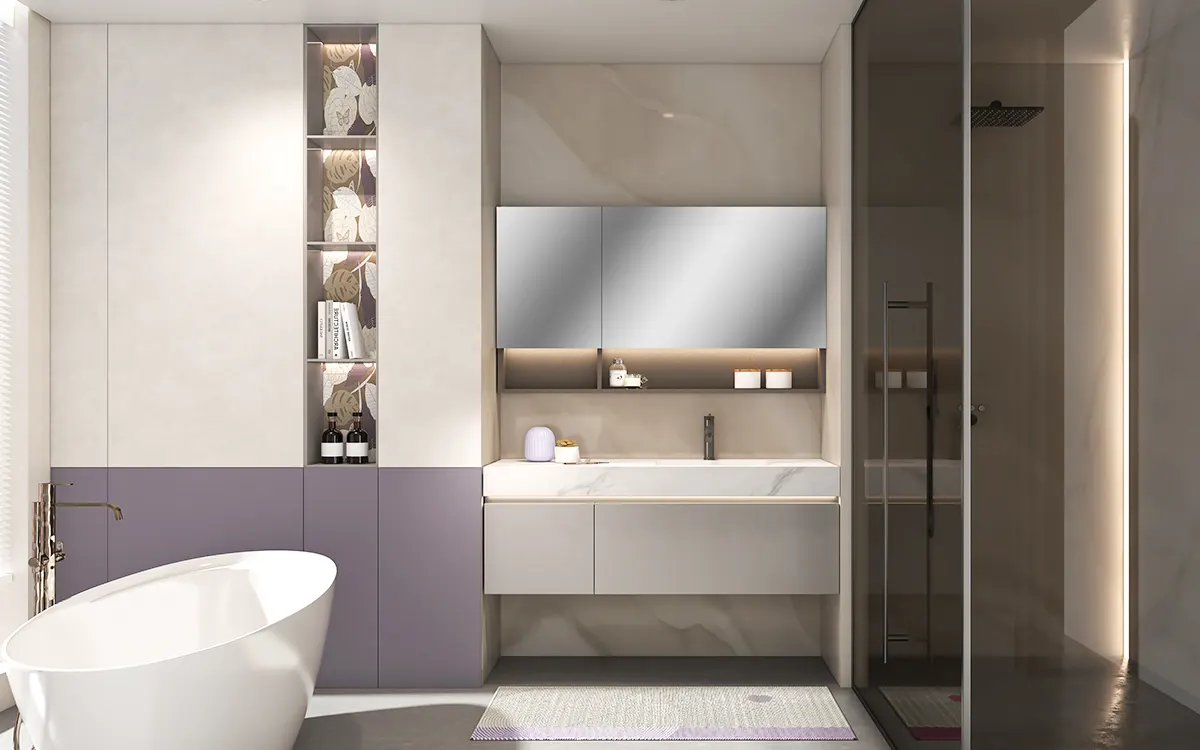
A bathroom vanity should not be designed only for appearance. Storage is one of its primary functions.
A well-planned bathroom vanity cabinet provides storage for toiletries, cleaning products, towels, cosmetics, hair care equipment, and other frequently used items.
In compact HDB bathrooms, drawers are often more convenient than deep cabinets because the items inside are easier to access. Internal dividers can further improve organisation.
Consider combining:
- Vanity drawers
- Under-basin storage
- Open shelves
- Mirror cabinets
- Tall side cabinets
- Integrated laundry or cleaning storage
A matching toilet cabinet can provide extra storage space without making the main vanity too big.
6. Coordinate the Vanity With the Overall Interior Design
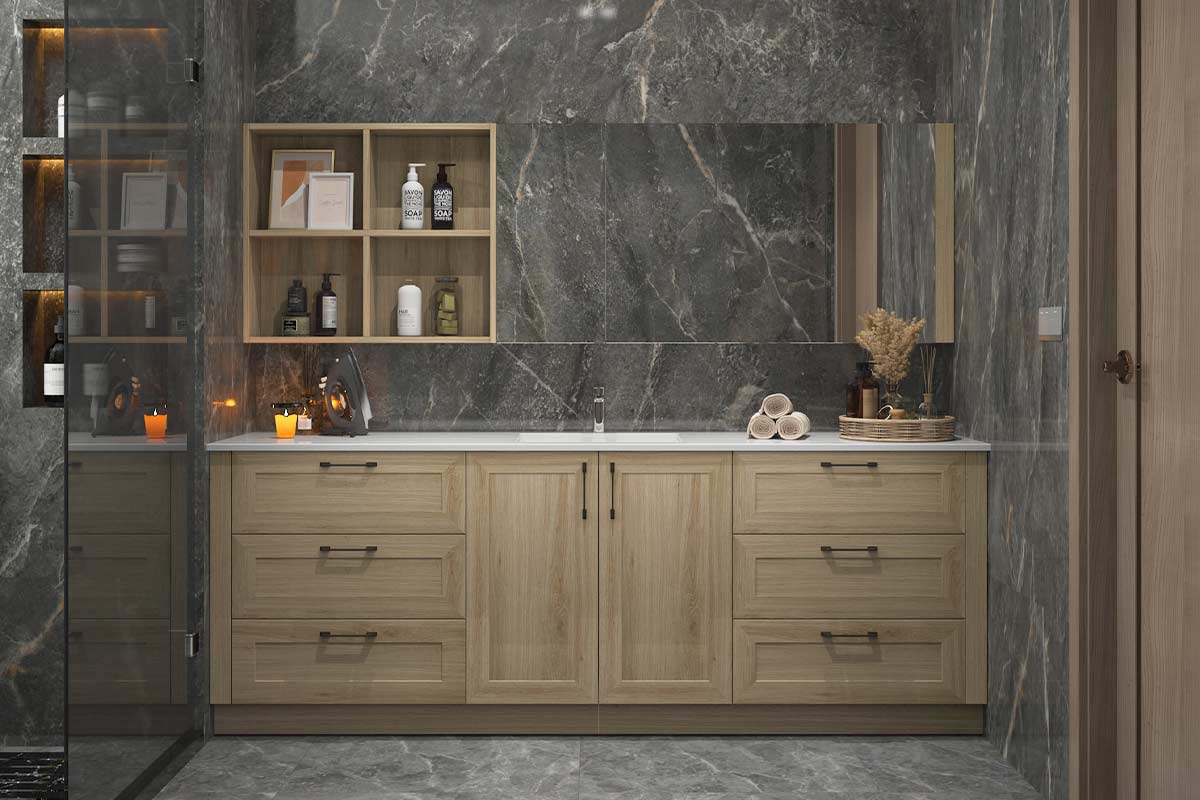
For professional residential projects, the vanity should be part of the bathroom’s overall design.
A wooden vanity can bring warmth to a minimalist bathroom, and matte finishes can complement contemporary or Scandinavian designs. Dark finishes create a luxurious appearance, and light colors make a compact bathroom appear brighter.
Designers should coordinate:
- Vanity front color
- Cabinet body
- Countertop
- Basin
- Tapware
- Mirror frame
- Wall tiles
- Floor tiles
- Shower fittings
- Bathroom accessories
For projects involving multiple bathrooms, manufacturers offering a wide selection of finishes can make it easier to maintain a consistent design language while varying cabinet sizes.
7. 5 Custom Bathroom Vanity Suppliers in Singapore
The following five companies are worth considering when sourcing custom or adaptable bathroom vanities for Singapore residential projects.
1. OPPOLIA
OPPOLIA is a Chinese manufacturer of custom home furnishings. They offer bathroom vanities, kitchens, wardrobes, interior doors, and whole-house solutions in Singapore. Its product portfolio is designed around custom cabinetry, making it suitable for contractors and designers managing multiple furnishing categories within one project.
For project professionals, one advantage is the ability to coordinate bathroom cabinetry with kitchens, wardrobes, doors, and other home furniture through a single supplier. OPPOLIA’s Singapore dealers also provide design, manufacturing, delivery, installation, and after-sales services.
Best for: Contractors, builders, interior designers, developers, and buyers seeking custom bathroom vanities together with broader whole-house cabinetry.
2. Soon Teck WoodWorks
Soon Teck WoodWorks is a Singapore-based custom carpentry manufacturer established in 1980. The company produces customised bathroom vanities and cabinets from its own factory and highlights materials designed to withstand Singapore’s humid climate. Marine-grade plywood is also available for projects requiring additional moisture resistance.
Best for: Singapore residential projects requiring locally manufactured custom wooden bathroom cabinetry.
3. CASAWAVE
CASAWAVE focuses on custom bathroom vanity solutions incorporating Corian integrated basins, waterproof cabinet construction, mirror storage, and moisture-resistant wall systems. Its solutions are specifically positioned for HDB and condominium wet areas.
Best for: Designers and contractors looking for integrated vanity-and-basin solutions for Singapore wet areas.
4. INOVO Singapore
INOVO offers customisable PVC bathroom vanity cabinets in multiple widths, including compact configurations designed for small HDB and BTO bathrooms. Its product range uses waterproof PVC construction and offers different countertop and basin options.
Best for: Projects prioritising waterproof construction, compact dimensions, and relatively standardised customisation.
5. HERA Bathroom
HERA Bathroom offers vanity and storage products designed specifically around Singapore bathroom dimensions. Its vanity cabinets use solid PVC construction and are available in several finishes and sizes, including options suitable for compact HDB layouts.
Best for: Residential projects that need waterproof PVC vanity construction with Singapore-oriented sizing.
Quick Comparison
| Supplier | Main Strength | Material | Best Fit |
| OPPOLIA | Custom cabinetry and whole-house solutions | 18 cabinet materials and finishes | Bespoke Singapore projects |
| Soon Teck WoodWorks | Local custom carpentry | Engineered materials, marine-grade plywood | Bespoke Singapore projects |
| CASAWAVE | Integrated vanity solutions | Waterproof cabinet + Corian | HDB and condo wet areas |
| INOVO | Compact customisable PVC vanities | Waterproof PVC | HDB and BTO bathrooms |
| HERA Bathroom | Singapore-oriented bathroom products | Solid PVC | Compact residential bathrooms |
8. Ask About Manufacturing and Installation Capability

A good vanity supplier should provide more than a product catalogue.
For professional projects, ask whether the manufacturer can support:
- Drawing and dimension confirmation
- Material and color selection
- Custom sizing
- Hardware specification
- Basin and countertop coordination
- Production drawings
- Quality inspection
- Delivery
- Installation
- After-sales support
This is particularly important for contractors handling multiple units. A supplier that can coordinate manufacturing and installation can reduce communication between different subcontractors.
9. Custom vs. RTA Bathroom Vanities

Not every project requires a fully bespoke cabinet.
Custom bathroom vanities are preferable when the bathroom has unusual dimensions, specific plumbing requirements, premium finishes, or detailed design specifications.
RTA vanities can be more appropriate for projects where dimensions are relatively standard, and the priority is faster installation or cost control.
For contractors and developers, the best choice depends on the project volume, bathroom layout, budget, schedule, and degree of design customisation required.
10. Final Checklist for Selecting HDB Bathroom Vanities
Before approving a vanity design, confirm the following:
- Accurate site measurements have been completed
- Vanity dimensions suit the available circulation space
- Basin and countertop dimensions are confirmed
- Plumbing locations have been coordinated
- Cabinet materials are appropriate for bathroom conditions
- Edge sealing and moisture protection have been considered
- Storage requirements have been discussed with the homeowner
- Doors and drawers have sufficient clearance
- Wall fixing is suitable for floating designs
- Countertop and basin installation details are coordinated
- Vanity finish matches the bathroom design
- Production and installation schedules are confirmed
- Warranty terms are clearly documented
A well-designed vanity should combine practical storage, durable construction, easy maintenance, and a finish that complements the rest of the home. For HDB projects, customisation is particularly valuable because the bathroom layout often leaves little room for error.
Looking for a Reliable Bathroom Vanity Manufacturer in Singapore?
OPPOLIA offers full-house solutions, covering everything from interior design and manufacturing to installation. With 18 materials and 113 vanity front colors to choose from, we can meet your needs, whether you require custom or RTA vanities for your residential project.
Learn more about the OPPOLIA bathroom vanities collection. If you’re looking for a reliable supplier or manufacturer, OPPOLIA is here to serve you. Tell us your requirements, and we’ll provide a free quote within 24 hours!
FAQs about bathroom vanity for HDB bathroom
A wall-mounted or compact custom vanity is often a practical choice for an HDB bathroom because it can be manufactured to suit the available wall width and circulation space. A floating design can also make the bathroom appear more open and simplify floor cleaning.
The best material depends on the project’s budget, design requirements, and moisture exposure. Moisture-resistant boards, quality laminates, PVC, acrylic, melamine, plywood, and marine-grade plywood can all be considered. The overall cabinet construction and edge sealing are also important.
There is no single ideal depth because bathroom layouts and basin designs vary. The vanity should be deep enough to accommodate the basin, plumbing, and required storage without unnecessarily reducing circulation space. Custom fabrication is useful when a standard vanity is too deep for the bathroom.
Not necessarily. A floating vanity can create a cleaner, more spacious appearance and make floor cleaning easier. A floor-standing vanity may provide greater storage capacity and can be more suitable where maximum cabinet volume is required. The best option depends on the bathroom layout and project objectives.
The cost depends on dimensions, materials, countertop, basin configuration, hardware, storage design, finish, and installation requirements. Contractors should obtain project-specific quotations rather than relying on standard retail prices, especially when multiple HDB units or customised dimensions are involved.